When the calendar breaks a rhythm that works
Under the week numbering we use in Sweden, 2026 has 53 weeks. Week 53 is followed by week 1 – in other words, two odd week numbers in a row. For families who plan where the children live based on even and odd weeks, two different ways of thinking can suddenly stop matching.
Continuing to switch every week is not the same as always having the children on the same even or odd week numbers. If you stick to the week numbers, the same parent may get two weeks in a row. If you keep switching every week, who has the even and who has the odd weeks changes after the new year instead.
Week 53 runs from 28 December 2026 to 3 January 2027. Week 1 starts on 4 January. It can help to look at those dates together with your actual handover days and any special arrangements for Christmas and New Year.
For some families it is a simple adjustment. For others it affects working hours, recovery, travel or a new partner's weeks with their children. It doesn't have to turn into a conflict, but it is easy to assume different things without noticing.
What matters to me in this change?
Before you suggest a solution, you can pause and separate the practical from the emotional. Is the worry about a shift that can't be moved? About missing a holiday? Or about a feeling of having to adapt yet again?
Self-knowledge here is not about analysing the other parent. It is about understanding what you yourself need to be able to put into words. That makes it easier to describe a concrete need, instead of getting stuck on who usually gets their way.
- What needs to work in practice for me and the children?
- What feelings does the change bring up – and what do I need to be able to put into words?
- What can I be flexible about, and what do I need to explain more clearly?
Open the conversation before plans are locked
A conversation in good time gives you the chance to explore the options before time off, trips and other plans are decided. If possible, choose a moment when you can talk without the children having to be there and listen. You could start like this:
“I noticed that week 53 is followed by week 1 and that it affects our usual schedule. Could we look at the dates together now? I want it to be clear for the children and for both of us to have time to plan. What does it look like for you?”
The wording is a suggestion, not a demand to find the right words. Start with what you can both see in the calendar, describe what you want clarity about and ask what it looks like for the other person. You don't have to agree with everything to try to understand a practical obstacle.
Make the plan concrete – and keep the children out of the negotiation
Put the calendar in front of you and write down possible arrangements with dates, not just week numbers. What happens over Christmas and New Year? Which day is the next handover? What do the first weeks of January look like? An option that sounds simple may only show its consequences a few weeks later.
Once you have agreed, summarise the plan in writing and check that you have understood it the same way. Also decide when you will tell the children, so that they get clear information without having to carry messages between you.
The children's needs and everyday life should have a place, but responsibility for solving the schedule lies with the adults. Children may need to share how the change feels without having to take sides or decide what is fair between their parents.
This is support for preparing a conversation, not legal advice. If you have an agreement or a court ruling and are unsure what applies, seek individual legal guidance. If you can't move forward, you can contact your municipality's family law services (familjerätten in Sweden) for information about mediated conversations. If there are threats or violence, safety comes first; a joint conversation is not always the right way.
Before the conversation – write three sentences
Take a moment for yourself and finish the sentences below. Try to write so concretely that the other parent can understand what you mean:
- What matters most to me is …
- I would like to understand how you think about …
- One suggestion we could explore is …
Listen to the feature on Sveriges Radio P4
At Aivelyn we explore how self-knowledge can help us express our needs and understand each other better. That perspective matters even when a couple relationship has ended and the parenting continues. We can't change the calendar, but we can try to have the conversation before the change is at the door.
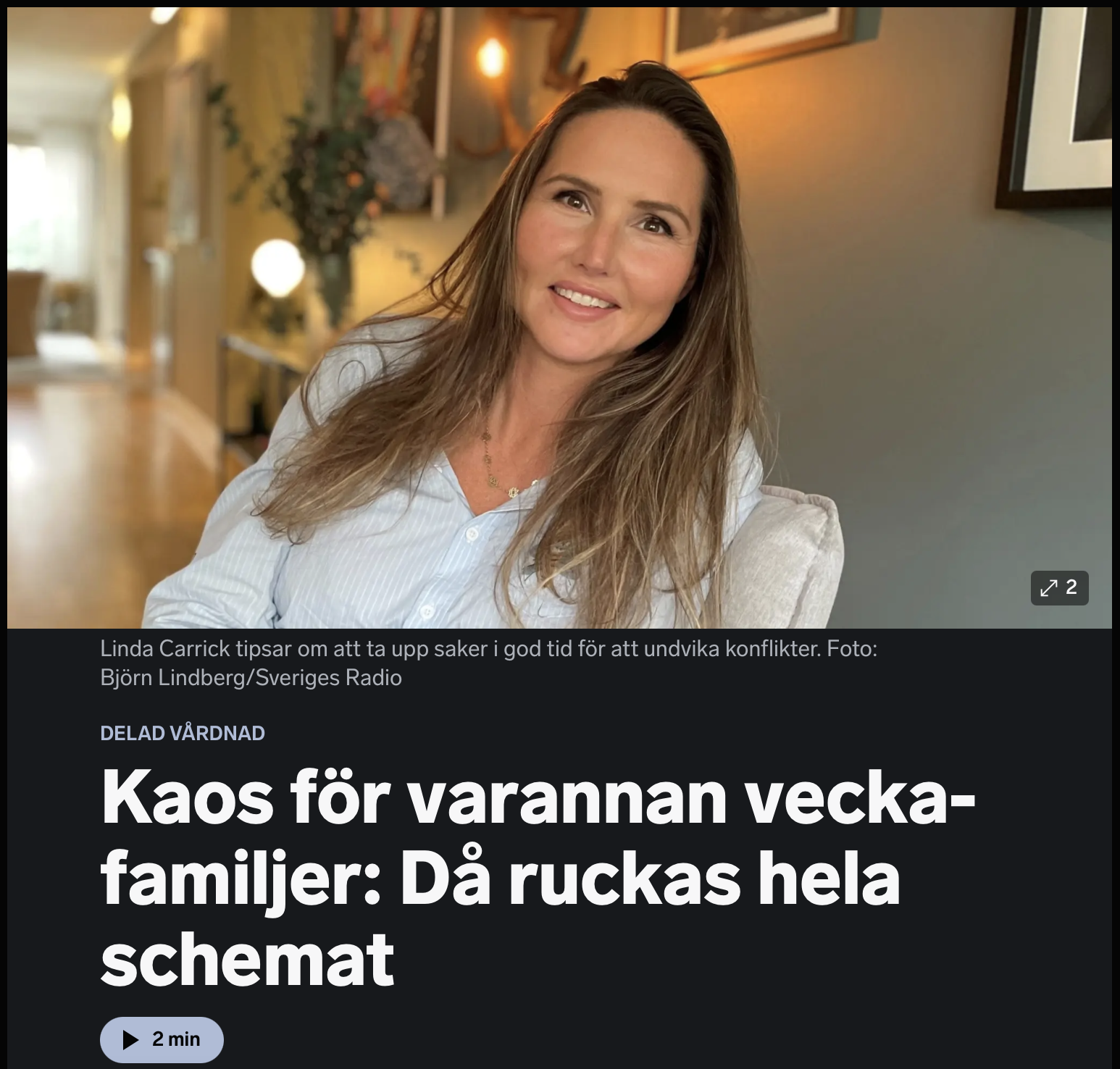
In P4 Stockholm's feature on 6 November 2026, I talk about how week 53 affects planning in my own family. The lawyer Pierre Kryhl also takes part. Thank you to Björn Lindberg and Sveriges Radio for raising the question.
The linked feature is in Swedish.
Linda Carrick, founder of Aivelyn
Listen and read at Sveriges Radio P4 Stockholm (in Swedish) →